Field note 008 · Root-zone control
Map the reservoir’s temperature range.
A single afternoon reading cannot tell you whether nutrient solution stayed stable, warmed under the lights, or fell sharply overnight. Survey one complete operating cycle first. Then match the correction to the crop, the duration of the excursion and the actual source of the heat or cold.
There is no universal “ideal” reservoir temperature
Hydroponic temperature advice is often reduced to one number. That shortcut hides the variables that matter: crop and cultivar, plant age, air temperature, light level, root-zone oxygen demand, system type and the length of time spent above or below a useful range. Start with a crop-specific university or production reference. Write down the intended range and the source beside the system; do not transfer a lettuce trial directly to basil, tomato or strawberry.
Purdue Extension’s winter greenhouse lettuce trial illustrates why context matters. Researchers compared nutrient-solution treatments near 60, 63, 67 and 70°F under cool-air conditions, and growth increased across that particular experiment, with the greatest observed growth at a measured solution temperature of 71.4°F. That is evidence about lettuce in the described winter trial—not a universal hydroponic set point.
Cornell’s controlled-environment lettuce research also treated air and root temperature as interacting variables. Its handbook describes combinations of 17, 24 and 31°C air and water conditions and reports that root temperature contributed to final dry weight and quality. The practical lesson is to record room and solution temperature together. A reservoir number without its environment is incomplete.
Act on a trend, not a stray reading. Compare the daily high, daily low, duration outside the crop-specific range and plant response. If the probe, location or clock changes, mark the change in the log.
Survey one complete light and dark cycle
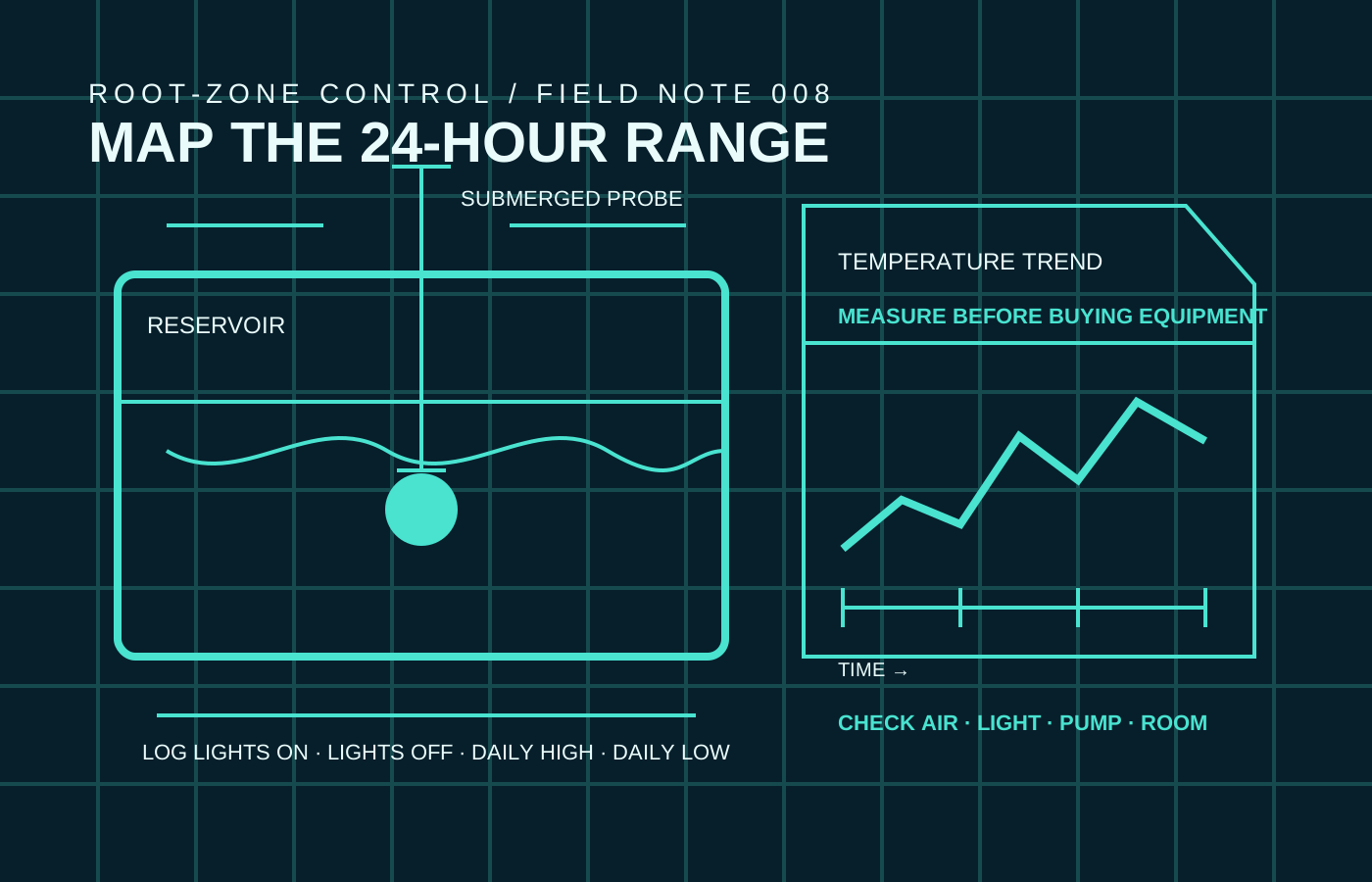
Measure before changing anything. A 24-hour record captures the heat stored by lights and pumps, the lag after lights-off, and the coldest part of the night. If the system is outdoors, in a greenhouse or beside an exterior wall, a 48- to 72-hour survey across representative weather is more useful.
- Verify the thermometer or controller against its manufacturer’s check procedure. If accuracy matters, compare it with a traceable reference at a relevant temperature.
- Record reservoir volume, crop, growth stage, solution depth and probe location. Note whether the reservoir is topped off.
- Log solution and room temperature at lights-on, two hours later, midday, lights-off, two hours later and near the expected overnight low. A data logger can collect more points.
- Mark each event: nutrient mixing, top-off water, pump-cycle change, door opening, heater operation or unusual weather.
- Record the daily high and low, the time each occurred and the number of hours outside the crop-specific range.
- Repeat after any meaningful control change. Compare equal operating periods rather than isolated readings.
Water has thermal mass, so the solution peak may arrive after the room or lights peak. If a reservoir climbs for hours after lights-off, inspect stored heat, warm return lines and pump motors. If the solution drops rapidly when irrigation stops, examine exposed plumbing and reservoir insulation.
Put the probe in representative moving solution
A probe beside a heater reports the heater. One in a warm return stream reports the return. One pressed against a cold wall reports the wall. Place the sensing area in the well-mixed body of the reservoir, fully submerged to the specified depth and clear of roots, air stones, pump intakes and direct light. Secure the cable so the sensor cannot migrate.
For a deep or poorly mixed tank, compare upper and lower readings before choosing the permanent location. A persistent difference indicates stratification and a circulation problem, not merely a logging problem. Do not immerse a display, connector or cable section that is not rated for submersion. Follow the exact sensor’s cleaning and waterproofing instructions.
Record temperature beside the pH, EC and volume trend. Top-off water can change all four. A sudden low temperature paired with a volume increase may simply describe a cold refill; a gradual temperature rise with falling volume points toward a different cause.
Trace the heat or cold to its source
| Observed pattern | Likely contributors | Check next |
|---|---|---|
| Rise begins after lights-on | Radiant light, warm canopy air, enclosed cabinet | Shade the tank, log room air, inspect ventilation |
| Warm spot near return | Pump heat, warm tubing, lamp-heated grow channel | Compare return and tank temperatures |
| Slow rise all day | Room heat, undersized reservoir, exposed dark surface | Review room peak and reservoir sizing |
| Sharp overnight fall | Cold floor, exterior wall, exposed plumbing, cold intake air | Compare floor, wall and room readings |
| Top and bottom differ | Weak circulation or sensor location | Map depths; correct mixing without stressing roots |
| Reading jumps with top-off | Refill water temperature | Record refill volume and temperature |
Map the energy path instead of treating the reservoir as an isolated box. Pumps add heat to water; lights can warm both the tank and the solution returning from channels; an air pump can move room-temperature air into the root zone; and long tubing exchanges heat with its surroundings. Change one factor at a time and rerun the same survey.
Reservoir volume changes the response speed. A small volume can swing quickly when the room changes or cold water is added. Use the reservoir operating-envelope guide to compare usable volume, daily drawdown and freeboard before solving every swing with equipment.
Correct location, exposure and timing first
Passive controls are easier to verify and less likely to introduce a new failure point. Keep opaque reservoirs out of direct sun and intense lamp radiation. Leave safe clearance around electrical equipment and vents. Insulate the tank from a cold floor or hot wall with a moisture-tolerant material that can be inspected and cleaned. Insulate exposed supply and return lines when the room-to-solution difference is significant.
Move the reservoir only if plumbing, access, leak containment and pump head still work. Do not wrap a motor, ballast, driver or power supply that needs ventilation. Avoid improvised insulation that absorbs spills or hides leaks. If a cover reduces evaporation, keep needed aeration and access; do not seal a system that is designed to exchange air.
Schedule top-offs consistently and avoid large, abrupt temperature changes. Mix nutrients according to their labels and the system plan. Penn State Extension notes that fertilizer solubility varies with water temperature, another reason to document mixing-water conditions rather than treating temperature as a separate issue.
Buy a heater or chiller only from a measured load
Active temperature control is justified when passive changes cannot keep a crop-specific operating range through representative conditions. Size it from reservoir volume, the required temperature change, room extremes, lighting and pump heat, plumbing exposure and recovery time. Marketing capacity without those conditions is not a design calculation.
- Use equipment listed and rated for the liquid, environment and continuous duty expected.
- Choose an independent high- or low-temperature alarm where a controller failure could damage the crop.
- Keep mains connections dry, elevated and protected as required by local electrical rules. Use ground-fault protection where required.
- Place the controlled outlet and sensor so short-cycling and local hot or cold spots do not fool the controller.
- Preserve circulation during control so conditioned water reaches the whole root zone.
- Test the failure state: unplugged probe, stuck output, lost circulation and power restoration.
Do not use frozen bottles or ice as an unlogged permanent strategy. They can produce local cold zones, contaminate solution if damaged and cause inconsistent control. If a temporary sealed heat exchanger is used during an emergency, sanitize its exterior, keep it intact, log the change and continue measuring.
Read temperature, aeration and root condition together
Oklahoma State University Extension notes that oxygen solubility decreases as water temperature increases. At the same time, roots and microbes consume oxygen. A warm reservoir can therefore narrow the system’s margin even when temperature alone has not reached a dramatic number. Check aeration, circulation, root condition and cleanliness together.
Low dissolved oxygen can reduce nutrient uptake and growth and can favor unhealthy root-zone conditions. A dissolved-oxygen meter adds useful evidence only when it is maintained and calibrated. Without one, do not claim an oxygen concentration from bubble appearance. Instead, verify that the air system is sized and distributed, inspect for blocked diffusers and maintain the cleaning schedule.
Temperature compensation on pH or EC instruments does not make the nutrient solution chemically unchanged. It adjusts the measurement response according to the instrument design. Keep the actual solution temperature in the record, and calibrate pH and EC meters before using small shifts to justify dosing.
Print the 24-hour temperature survey
Reservoir temperature survey
Date / crop
Reservoir volume
Crop target + source
Probe / location
Lights on
Lights off
Daily high / time
Daily low / time
| Time | Solution | Room | Volume | Event / observation |
|---|---|---|---|---|
| Lights on | ||||
| +2 hours | ||||
| Mid-cycle | ||||
| Lights off | ||||
| +2 hours | ||||
| Overnight low |
Change tested and result
Keep the completed sheet through at least one seasonal change. The value is not the paperwork; it is the comparison. A later survey shows whether insulation, a location change or active control actually narrowed the operating range without creating a new overnight problem.
Sources checked
- Purdue Extension — Improving Winter Greenhouse Lettuce Production by Using Heated Nutrient Solution
- Cornell Controlled Environment Agriculture — Hydroponic Lettuce Production Handbook
- Oklahoma State University Extension — Principles of Small-Scale Aquaponics
- Oklahoma State University Extension — Aquaponics: Integrating Fish and Plant Culture
- Penn State Extension — Hydroponics Systems: Nutrient Solution Programs and Recipes
Research reviewed November 10, 2026. Crop-specific guidance, equipment manuals, product labels and applicable electrical rules control the installed system.