Field note 002 · Nutrient solution
Stop chasing pH. Build a seven-day reservoir log.
One reading tells you where the solution is now. A consistent log shows whether water, dissolved ions, temperature, crop demand, or the measurement process is moving.
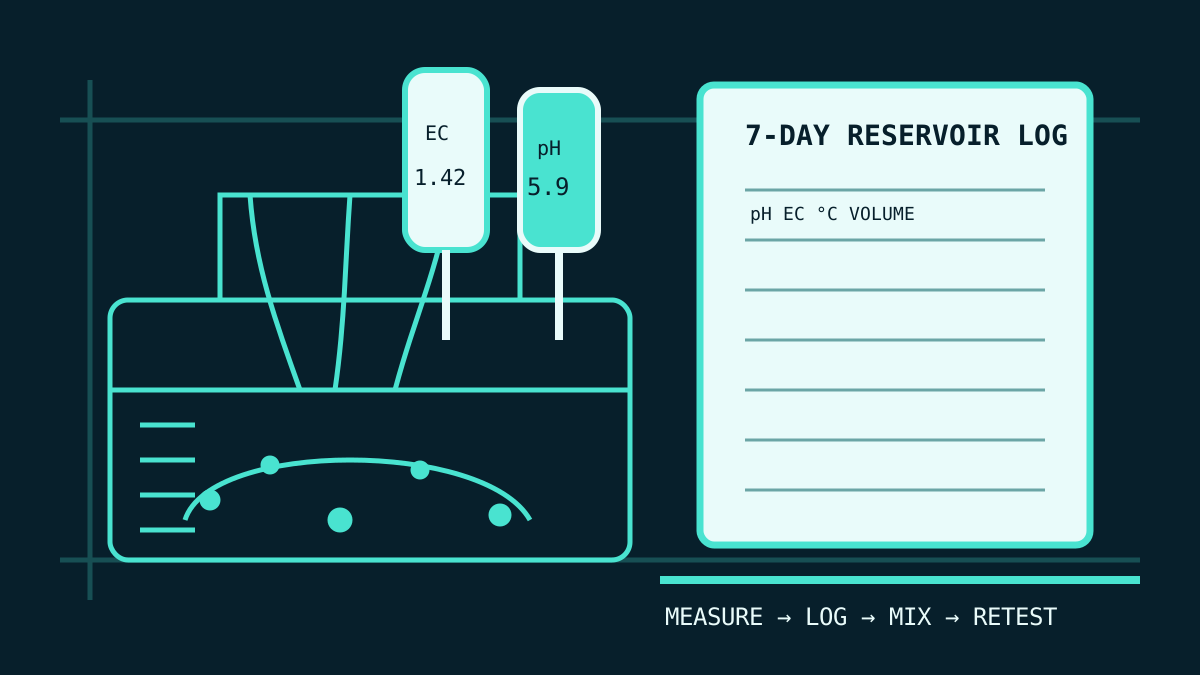
Hydroponic growers often react to the number that moved most recently. pH is high, so acid goes in. EC is low, so concentrate follows. The next reading changes again, and the reservoir becomes a sequence of corrections without a record of what caused them.
A better starting point is a small operating log. Record pH, electrical conductivity, solution temperature, actual solution volume, additions, crop stage, and what the roots and equipment look like. Use the crop’s nutrient program and your source-water analysis as the target. The trend then becomes a troubleshooting tool, not an automatic dosing command.
Follow the product label and safety data sheet. Wear specified protection, add small measured amounts to a circulating reservoir, keep acids and bases separate, and never mix concentrated stock solutions together unless the formulation explicitly directs it.
1. Establish the water and crop baseline
Nutrient solution begins with source water. University of Missouri Extension’s 2026 hydroponic nutrient guide recommends testing source water for pH, EC, alkalinity, and individual elements. EC shows how well the solution conducts electricity and serves as a proxy for total dissolved ions; it does not tell you which nutrients are present or whether their proportions are correct.
Alkalinity is different from pH. It describes the water’s capacity to neutralize acid. Two water sources can start at a similar pH but need very different amounts of acid to move and hold that pH. A reservoir that repeatedly rebounds after an adjustment may be pointing to source-water alkalinity or another system process, not to a weak dose.
Write down:
- Source-water pH, EC, alkalinity, and lab date.
- Crop and cultivar, growth stage, and number of plants.
- System type, growing medium, and nominal versus actual operating volume.
- Nutrient product, lot, recipe, mixing order, and target range from the crop program.
- Top-off water type and any treatment.
- Normal lighting, room temperature, airflow, irrigation, and aeration schedule.
Do not borrow one universal pH or EC number from a chart without checking crop, stage, system, water, and fertilizer. Missouri Extension describes 5.5–6.5 as a rule-of-thumb pH range for many hydroponic crops while explicitly noting exceptions and directing growers to crop-specific requirements.
2. Measure the same way each time
Consistency makes the log comparable. Sample at the same point in the circulation loop and at roughly the same time relative to lights, irrigation, top-off, and nutrient additions. Let the reservoir circulate long enough to mix, follow the meter’s immersion depth, and wait for the reading to stabilize.
- Record the date, time, crop stage, and whether lights and pumps are running.
- Read actual solution volume from a marked reservoir or measured top-off.
- Record solution temperature before it changes in the sample cup.
- Rinse the probe as its instructions require; do not wipe or rub a glass pH bulb.
- Measure pH and EC in a clean sample or in the reservoir as the instrument allows.
- Record units exactly. mS/cm and µS/cm differ by a factor of 1,000; “ppm” conversions vary by meter scale.
- Inspect roots, smell, clarity, leaks, air flow, pump flow, emitters, and light reaching the solution.
- Record every top-off, nutrient addition, pH adjustment, cleaning step, and solution change.
Take a second reading when a number looks implausible. First check calibration status, unit, temperature compensation, contamination, and mixing. A bad measurement should not become a chemical adjustment.
3. Read pH, EC, temperature, and volume together
The patterns below are prompts for investigation, not diagnoses. Plants absorb water and ions at different rates; evaporation, source water, fertilizer balance, crop stage, microbes, leaks, and meter error can produce similar trends.
| Observed pattern | Questions to ask before adjusting |
|---|---|
| Volume falls; EC rises | Did water leave faster than dissolved ions? Check heat, airflow, leaks, plant demand, top-off practice, and meter units. |
| Volume falls; EC falls | Is the crop taking up ions along with water, or was the reservoir diluted? Confirm recipe, source-water EC, plant load, and meter calibration. |
| EC steady; pH drifts | What is the water alkalinity? Has crop stage, nutrient form, microbial activity, root health, or adjustment history changed? |
| Both EC and pH jump after dosing | Was the concentrate measured, added in the correct order, and fully mixed? Was the sample taken too soon or near the dosing point? |
| Temperature rises; roots change | Is light heating the reservoir? Is circulation or aeration reduced? Warm water holds less dissolved oxygen. |
| Numbers change with no system event | Are buffers fresh, probe storage correct, units unchanged, and sensors clean and calibrated? |
EC can be on target while individual nutrients are out of balance. Missouri Extension specifically warns that source water can contribute ions and that fertilizer selection can leave individual nutrients mismatched even when the total conductivity looks correct. Persistent plant symptoms require a wider review and may justify source-water, solution, tissue, or root-zone testing through an appropriate laboratory or Extension service.
4. Temperature belongs on every line
Temperature affects roots, microbes, meter readings, and oxygen capacity. Missouri Extension notes that warmer water holds less dissolved oxygen and recommends monitoring both water temperature and dissolved oxygen in deep-water culture and aquaponic systems where roots remain submerged.
Do not respond to warm solution only by adding more air. Find the heat source: light striking the reservoir, warm room air, a pump adding heat, undersized volume, dark exposed tubing, or a chiller problem. Shade or insulate appropriately without blocking equipment ventilation or service access. Keep electrical connections and air pumps arranged according to their safety instructions.
5. Treat pH drift as information
pH affects nutrient solubility and availability, but a single out-of-range reading does not explain why it moved. Verify the meter, confirm the crop target, review alkalinity and recent additions, and inspect the roots and solution. When adjustment is appropriate, follow the nutrient program and chemical label, measure carefully, allow complete circulation, and retest after a defined interval.
Avoid large alternating doses of acid and base. They add ions and make the log harder to interpret. If small corrections repeatedly fail to hold, stop and investigate source water, reservoir volume, nutrient recipe, plant load, contamination, and equipment rather than escalating the dose.
6. Maintain the measurement system
University of Missouri Extension recommends calibrating hydroponic meters periodically and gives a weekly two-point pH calibration at pH 4 and 7 as its production guidance. Your instrument’s current manual controls the exact buffers, order, frequency, slope limits, and temperature requirements.
- Use fresh, unexpired calibration standards and never pour used buffer back into the bottle.
- Record the buffer lot, expiration, pre-calibration reading, result, and date.
- Rinse with distilled or deionized water between standards and samples as directed.
- Store a glass pH electrode in the specified storage solution. Missouri Extension warns never to store it submerged in water.
- Keep the sensing bulb wet as instructed and do not touch, scratch, or wipe it.
- Clean an EC probe with the maker-approved method; deposits can slow or bias readings.
- Replace a probe that cannot calibrate or stabilize within the manufacturer’s limits.
When comparing meters for a future purchase, prioritize replaceable probes, published accuracy over the working range, clear calibration steps, available standards and storage solution, water and shock protection, unit control, temperature compensation details, and a service path. Product listings, prices, and checkout on this site remain disabled until authorized supply and verified specifications are documented.
The seven-day reservoir log
Calibrate meters. Mark operating volume. Record source water and fresh mixed solution after full circulation.
At the same daily checkpoint, log volume, temperature, pH, EC with units, roots, solution, equipment, and crop observations.
Write the exact amount, product, time, reason, and reading after adequate mixing. Do not record “adjusted” without numbers.
Graph all four measurements. Compare changes with lighting, top-offs, crop growth, room conditions, and maintenance.
The goal is not a perfectly flat line. It is a system you can explain. A stable process makes real departures visible and gives an Extension specialist, crop adviser, or supplier enough context to help.
Use the homepage workspace planner to list system questions, and review the listing standard before evaluating meters, pumps, aeration, reservoirs, or dosing equipment.