Field note 007 · Measurement QA
Calibrate the meter before you correct the reservoir.
When pH or EC looks wrong, the number can describe the solution, the sampling method, a contaminated standard, a dry or fouled probe, a unit setting—or some combination. A short verification sequence keeps one questionable reading from becoming an unnecessary reservoir correction.
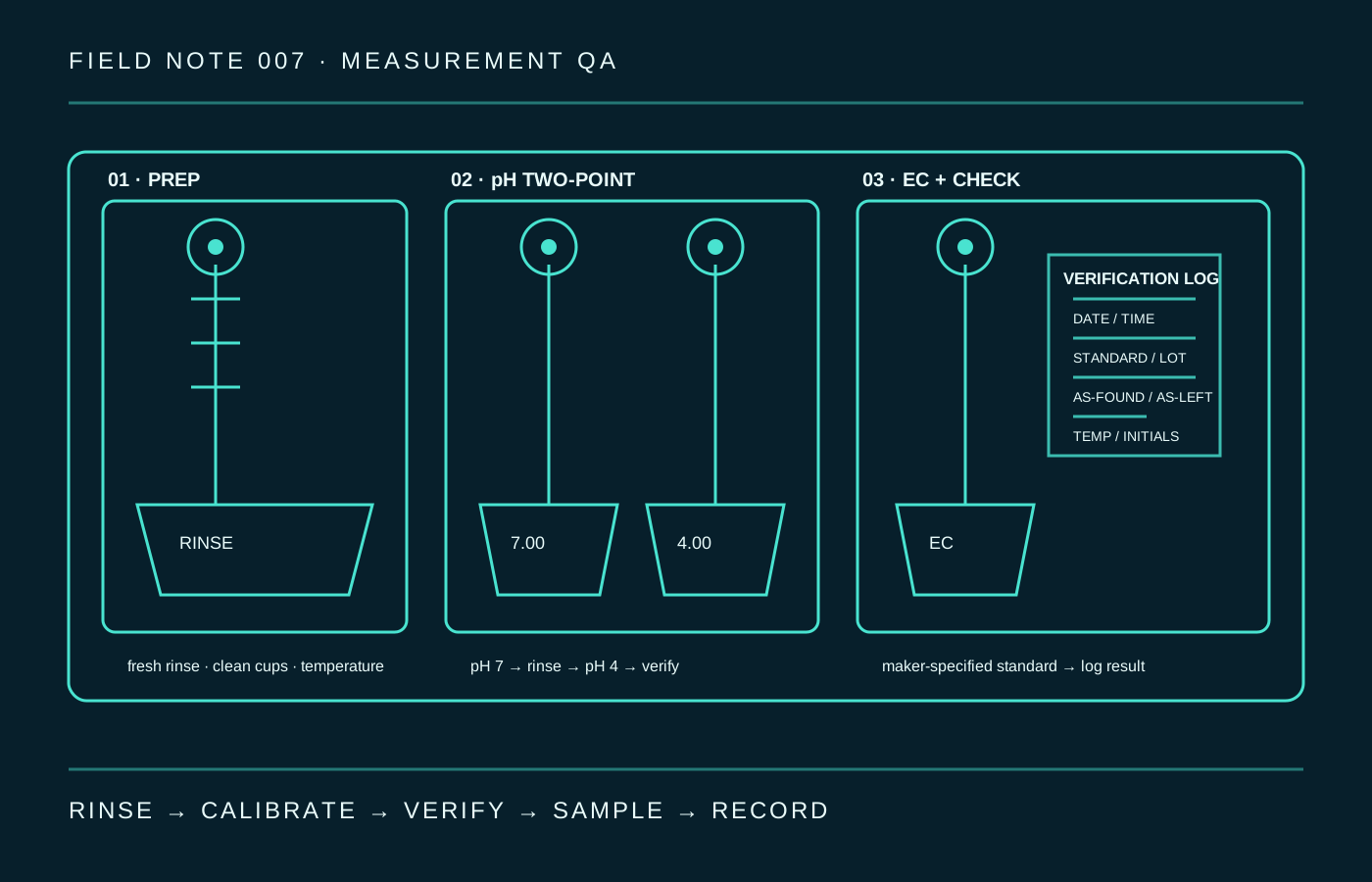
pH and EC answer different questions
A pH meter estimates hydrogen-ion activity. In a hydroponic nutrient solution, that reading helps describe the chemical environment that affects nutrient availability. An EC meter measures electrical conductivity: the combined ability of dissolved ions to carry current. EC is useful for tracking total ionic strength, but it cannot identify which nutrients are present or prove that their proportions are correct.
That distinction matters when troubleshooting. A normal EC does not rule out a nutrient imbalance. A pH shift does not prove the meter is wrong. University of Missouri Extension recommends measuring pH and EC together and notes that nutrient solutions change as plants and microbes use water and nutrients. Keep volume and solution temperature in the same record so the readings have context.
Never dose a reservoir from a reading you cannot reproduce. First confirm the meter against a known standard, repeat the sample in a clean cup, and check the unit and temperature. Then change one variable at a time.
Build a clean calibration station
Calibration is a comparison against a known standard, not merely a button press. Set out the meter manual, fresh standards specified by the manufacturer, separate clean cups, distilled or deionized rinse water, a thermometer if temperature is not displayed, and the log below. Let meter, standards and samples reach stable conditions unless the product instructions specify otherwise.
- Read the meter’s accepted pH buffers and EC standard values. Not every meter recognizes the same set.
- Check expiration, lot number, contamination, crystals, cloudiness and storage history. Replace questionable standard.
- Pour only a small working portion into a labeled cup. Never calibrate in the source bottle or pour used solution back.
- Use a separate cup for each buffer and for rinse water. Keep caps paired with their bottles.
- Inspect the probe for dried deposits, cracks, trapped bubbles, damaged cable, low battery or an empty storage cap.
- Record the reading in standard before adjusting it. This “as-found” value tells you how far recent reservoir records may have drifted.
Public grower discussions repeatedly describe the same failure pattern: a surprising reservoir reading leads to dosing, the plants worsen, and only later does a buffer check reveal a drifting meter. Treat the standard check as part of measurement, not as occasional repair.
Use a two-point pH calibration that brackets the work
For the acidic range used by many hydroponic crops, pH 7 and pH 4 buffers commonly bracket the working measurement. University of Missouri Extension recommends a weekly two-point calibration at pH 4 and 7 for routine hydroponic meter care. Your meter’s current manual controls the exact order, buffer values, acceptance messages and calibration interval.
- Condition or hydrate the probe exactly as the manufacturer directs. A pH glass bulb and reference junction are not stored like an EC sensor.
- Rinse the sensor with distilled or deionized water. Gently shake off droplets or blot as directed; do not wipe or rub the glass bulb.
- Place the probe in the first fresh buffer with the sensing area fully immersed. Move gently to release bubbles, then wait for the meter’s stability criterion.
- Write the as-found value and temperature. Start calibration and accept the standard only when stable.
- Rinse into the waste or rinse cup. Do not carry the first buffer into the second.
- Repeat in the second buffer, then complete the meter’s calibration routine.
- Rinse and return to one fresh verification portion. Record the independent post-calibration reading.
If the meter rejects a buffer or never stabilizes, stop. Confirm the correct buffer set and mode, fresh solution, proper immersion, probe hydration and clean junction. Follow the manufacturer’s cleaning instructions. Do not compensate by repeatedly accepting a moving value.
Store the pH probe in the specified storage solution. Missouri Extension explicitly warns against storing a pH probe submerged in water; pure water can damage or deplete the reference system. Keep the bulb moist only by the method prescribed for the exact probe.
Match the EC standard, unit and range
Oklahoma State University Extension describes calibration with a conductivity standard, commonly 1.41 mS/cm. The right point is the one supported by the meter and appropriate to the measurements. Follow the meter manual rather than forcing a familiar number.
| Display | Equivalent | Common mistake |
|---|---|---|
| 1.413 mS/cm | 1413 µS/cm | Reading 1413 as 1.413 without checking the unit |
| 2.00 mS/cm | 2000 µS/cm | Recording only “2.00” |
| ppm or TDS | A calculated value | Comparing meters that use different conversion factors |
- Confirm the meter’s EC mode, standard value, displayed unit and temperature-compensation setting.
- Rinse the sensor, shake away trapped bubbles and immerse it to the required depth in a fresh working portion.
- Let temperature and reading stabilize. Record the as-found EC and temperature.
- Run the manufacturer’s calibration routine. Do not enter a value that differs from the standard label.
- Rinse, then verify in a separate fresh portion if accuracy matters to the decision.
- Record the as-left value, unit, temperature, standard lot and any cleaning performed.
EC sensors and pH electrodes have different storage and cleaning requirements. Do not apply pH storage advice to an EC probe or assume a combination instrument has one maintenance rule for every sensor.
Make the reservoir sample reproducible
A calibrated meter can still produce a poor measurement. Test a representative, well-mixed solution rather than a stagnant corner, concentrated dosing plume or surface film. Let recently added water, nutrient concentrate or pH adjuster circulate fully. Avoid touching the probe to roots, solids, container walls or an air stone.
For a repeatable bench method, collect enough solution in a clean cup to cover the sensing area. Record where and when the sample was taken, reservoir volume, solution temperature, pH and EC with units. Rinse between standards and samples so fertilizer does not contaminate calibration cups.
UMass Extension recommends allowing the reading to stabilize and gently moving the pen to release bubbles. It also points out that source-water EC should be separated from fertilizer contribution when checking an injector or recipe. A source-water baseline is useful in home systems too: reservoir EC includes ions that arrived before fertilizer.
Oklahoma State advises setting EC first and then checking pH. Whatever the target, use a crop-specific reference rather than one universal hydroponic number. Mix, wait and retest after each small correction.
When two readings disagree, run a decision tree
| Pattern | Check next | Decision |
|---|---|---|
| Meter misses fresh standard | Mode, standard, temperature, cleaning, hydration and battery | Recalibrate or remove from service |
| Meter passes standard but sample drifts | Mixing, bubbles, temperature, sample location and stabilization time | Repeat a controlled sample |
| Two EC meters differ only in ppm | Compare native EC unit and TDS factor | Standardize records on EC |
| Both pass standards but reservoir changes fast | Volume loss, dosing, crop uptake, temperature and circulation | Troubleshoot the system |
| Calibration will not complete | Fresh correct standard and maker troubleshooting | Clean, service or replace |
A second meter is useful only if it is independently checked. Two unverified instruments do not create a trustworthy average. If a decision could damage a crop or trigger aggressive dosing, retain a clean sample and seek an independent laboratory or Extension test.
Print a measurement QA log
pH + EC calibration and verification
Date / time
Operator
Meter / probe ID
Battery / condition
pH buffers + lots
EC standard + lot
Standard temperature
Compensation setting
pH as found
pH as left
EC as found + unit
EC as left + unit
Reservoir pH
Reservoir EC + unit
Reservoir temperature
Reservoir volume
Cleaning, faults, corrective action, next check
Keep the log beside the seven-day reservoir record. The as-found result establishes whether earlier trends remain believable; the as-left result establishes meter condition before the next sample.
Know when calibration is not a repair
Calibration aligns a functioning sensor with known standards. It cannot repair cracked glass, a damaged cable, depleted reference electrolyte, severe fouling, water intrusion or electronics that will not hold a setting. Missouri Extension notes that pH probes commonly have a shorter service life than EC probes and should be replaced when they can no longer be calibrated.
Remove a meter from decision-making when it cannot pass a fresh independent verification, response time remains impractical after approved cleaning, readings move erratically in a stable standard, or the probe shows physical damage. Mark it clearly so another person does not return it to use.
Finish by setting the next check date. Calibrate on the maker’s schedule, but verify sooner after long storage, a dry probe, cleaning, a battery or probe change, extreme temperatures, a drop, an implausible reading, or before a consequential reservoir adjustment.
Sources checked
- University of Missouri Extension — Hydroponic Nutrient Solutions
- Oklahoma State University Extension — Electrical Conductivity and pH Guide for Hydroponics
- UMass Extension — How to Use pH and EC Pens
- Virginia Cooperative Extension — Hydroponic Production of Edible Crops
Research reviewed November 4, 2026. The exact meter manual, standard label, crop requirements and chemical product directions control the installed workflow.